
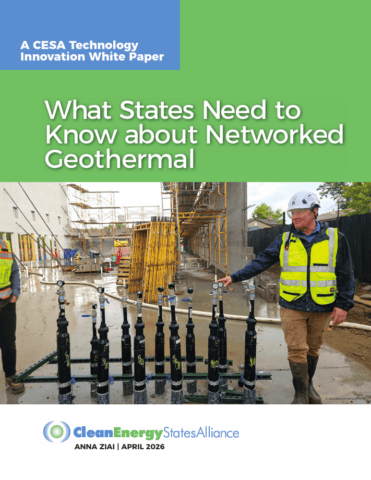
What States Need to Know About Networked Geothermal
Anna Ziai | Clean Energy States Alliance
Networked geothermal—also referred to as “ambient loop systems” or “community geothermal,” among other terms —is gaining attention among states, utilities, and local governments. Several gas utilities are piloting projects, states—including Colorado, Massachusetts, Minnesota, and New York—have authorized or required pilot programs, and federal funding has supported early demonstrations.
Networked geothermal raises policy, regulatory, financing, and equity questions. This short paper by the Clean Energy States Alliance (CESA) answers foundational questions about networked geothermal. It is intended to support early understanding and decision-making by CESA Members and other state officials.
The report addresses the following questions:
- What is networked geothermal?
- What problems does networked geothermal solve?
- What does a networked geothermal system look like?
- Where does networked geothermal make the most sense?
- How much does networked geothermal cost?
- Who owns and operates networked geothermal?
- What role can utilities play?
- What policy and regulatory issues do states need to understand?
- How can states support early projects and pilots?
- How can networked geothermal advance equity and affordability goals?
- What workforce considerations should states be aware of?
- Do geothermal networks qualify for federal tax credits?
Learn more: CESA staff sat down with Bryce Carter, Geothermal Program Manager at the Colorado Energy Office, to talk about the efficiency of geothermal heat pumps and the potential for networked geothermal—interconnected geothermal systems that span across multiple buildings—to revolutionize clean heating and cooling. Watch the 1-minute interview below.
Associated Project(s):
Resource Details:
Date: April 29, 2026
Type: Report
Topic(s): 100% Clean Energy, Distributed Generation, Geothermal Networks, Grid Modernization