
Building the Foundation: How Offshore Wind Projects are Developed
Developing an offshore wind project in the United States is a complex multiyear endeavor. It involves all levels of government, the power and labor of several industrial sectors, and the input of scientists, engineers, and the general public. This page will introduce you to some of the key government agencies, technologies, and processes that take an offshore wind farm an idea to a functioning power plant.
CESA publishes a new installation of "Building the Foundation" in every Offshore Wind Accelerator Newsletter. Subscribe to never miss a new post.
Anatomy of a Wind Farm
From CESA’s August 2025 OWA Newsletter
Read Anatomy of a Wind Turbine here. This month, we look at the other major components that make up an offshore wind farm, often called the “balance of plant.” Read Anatomy of a Wind Turbine here. This month, we look at the other major components that make up an offshore wind farm, often called the “balance of plant.” (opens in new tab)
Read Anatomy of a Wind Turbine below(opens in new tab). Here, we look at the other major components that make up an offshore wind farm, often called the “balance of plant.”
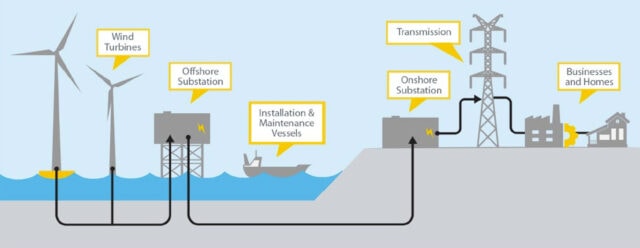
Image credit: Jennifer Breen Martinez, National Renewable Energy Laboratory
|
1. Wind Turbines are the fundamental unit of a wind farm. Modern turbines typically generate between 12 and 15 MW, but 18 MW models are under commercial development, and researchers are testing models that could generate more than 20 MW. 2. Array Cables transport the electrical power generated from each turbine in a wind farm to one or more offshore substations. Array cables are buried under the seafloor. 3. Offshore Substations collect the electrical power from individual turbines and adjust the power to a higher voltage. Transporting power at a higher voltage decreases the amount of power lost during its transmission to shore. Large offshore wind farms typically have two or more offshore substations. Many of the newer offshore substations convert the power from alternating current (AC) to direct current (DC), which allows the power to be transported longer distances with fewer losses. 4. Export Cables transport power from the offshore substation to shore. Recent wind farms have started to use high-voltage DC (HVDC) cables, which can transfer more power with fewer losses than traditional AC cables. Export cables are very thick—often nearly a foot in diameter—and are buried under the seafloor. Newer HVDC export cables are thinner, since they need only one wire, instead of the three that AC cables require. 5. Onshore Substations receive the power from the export cables and adjust the voltage and frequency of the power so that it can be used on the grid. This conversion requires the use of transformers and other industrial power equipment. If a project uses HVDC export cables, the substation will also need to convert the power back to AC for use on the grid. |
|
For more detailed information about these components, check out BVG Associates’ Guide to an Offshore Wind Farm. |